XT Appliances · Hazel Park, next door to Warren
Oven repair in Warren, MI
Burners that won't light, ovens that won't heat or run at the wrong temperature. A technician diagnoses it at your home and you approve the price in writing before any work.
- 25% off for seniors and veterans
- 90-day warranty
- Same-day most weekdays
What's your oven or range doing?
Pick the one closest to what you're seeing, gas or electric, and we'll show what it usually turns out to be.
Oven won't heat
On a gas oven it's usually an igniter that still glows but is too weak to open the gas valve; on an electric oven, usually a burnt-out bake element.
What it usually is
- Gas oven igniter (glow bar)An aging igniter keeps glowing but gets too weak to open the gas valve, so no gas reaches the burner. The tell: it glows for minutes and never lights, or lights late with a whump.
- Bake element (electric)The element at the bottom of the oven burns open, often at a blister or split. The tell: broil still heats but bake doesn't.
- Broil element (electric)The top element fails the same way. If the oven bakes but won't broil, this is the one.
- Thermal fuseA one-time safety fuse that opens when the oven runs too hot, most often during self-clean. The tell: the oven quit right after a clean cycle.
- Burnt terminal block or tripped breakerAn electric range runs on two power legs. Lose one, from a tripped half of the breaker or a burnt connection where the cord lands, and half the range goes dead: the oven quits while the cooktop still works, or the reverse.
Try this first
- On an electric range, check the breaker: a range uses a double breaker, and one half can trip on its own.
- On an electric oven, try broil and note whether the top element heats when the bottom one doesn't.
- On a gas oven, set it to bake and look through the window: note whether the igniter glows and whether a flame follows, then turn it off.
- Note the error code if the display shows one.
Stop using it and call now if
- If you smell gas, leave the house and call your gas company from outside. Don't switch lights or appliances on or off.
- The oven lights late with a whump, or smells of gas just before it lights.
- Sparks or arcing from an element, or a burning smell from the back of the range.
Burner clicks but won't light
Most often the burner cap is sitting crooked or its ports are clogged from a spill, which is a cleaning job, not a part.
What it usually is
- Burner cap off-center or clogged portsThe spark fires but the gas can't reach it in the right mix. The tell: you hear clicking and see the spark, but get no flame or only part of the ring.
- Wet or dirty igniterAfter a spill or a cleaning, moisture on the small ceramic igniter sends the spark to the grate or keeps it from firing. One burner won't light while the rest do, and it often recovers once dry. A cracked one needs replacing.
- Spark moduleOne module makes the spark for every burner. If none of them click or spark, it's the module or its power, not a single igniter.
- Igniter switch on one knobEach knob has a small switch that calls for a spark. One that sticks closed keeps the clicking going even with every knob off.
Try this first
- With the cooktop off and cool, lift each cap, wipe off any spill, and set it back flat and centered on its base.
- Clear any clogged burner ports with a straight pin, and let everything dry before you try again.
- If it started after a spill or a cleaning, give the burner and its igniter time to dry fully.
- If it won't stop clicking, turn each knob firmly to OFF, one at a time, and note which one stops it.
Stop using it and call now if
- If you smell gas, leave the house and call your gas company from outside. Don't switch lights or appliances on or off.
- A flame that still burns yellow or leaves soot after the cap is seated and clean.
- A burner that won't turn off.
Electric burner won't heat or won't shut off
Usually the burner's own element has burnt out, especially when one burner is dead and the rest still work.
What it usually is
- Coil elementA coil burns out at a burn spot or split, and that one burner goes dead while the others work. If it heats when moved to another burner of the same size, the coil is fine.
- Glass-top radiant elementEach zone under the glass has a sealed element. One zone that won't glow at any setting is usually its element; on a dual zone, only the inner or outer ring may quit.
- Burnt socket (coil tops)The socket the coil plugs into can overheat and scorch. The tell: the burner cuts in and out, or the coil's prongs look dark and pitted.
- Infinite switch behind the knobIf its contacts weld shut, the burner stays on high and won't turn down or off, which is a safety problem. If it fails open, a good element won't heat at any setting.
Try this first
- If several burners or the oven quit too, check the breaker: a range uses a double breaker, and one half can trip.
- On a coil top, with the cooktop off and cool, plug the dead coil into a working burner of the same size and see whether it heats there.
- Look at the coil or the glass for a visible split or burn spot.
Stop using it and call now if
- A burner stuck on high that won't turn down or off: switch off the range's breaker if you can do that safely.
- Sparks, arcing or a burning smell at a burner or its socket.
- A cracked glass top: stop using that cooktop.
Runs hot or cold, or bakes unevenly
Most often the oven's temperature sensor has drifted, so the oven heats to the wrong number.
What it usually is
- Oven temperature sensorThe probe that tells the control how hot the oven is drifts with age, so the oven heats to the wrong number. The tell: the elements or burner work, but the temperature is off.
- Door hinge or hinge springA broken spring or bent hinge lets the door sag or sit open a crack, and heat leaks out. The tell: a gap at the top of the door, slow heating, and trouble holding temperature.
- Convection elementThe element behind the rear fan heats the air in convection mode. If regular bake works but convection doesn't heat, this is usually it.
- Convection fan motorIf convection cooks unevenly while its element heats, or you hear grinding or rattling from the back in convection mode, the fan isn't moving the air.
- Gas oven burnerClogged ports or a mis-set air shutter give a yellow, weak or one-sided flame that heats unevenly. A yellow flame is also a safety sign.
Try this first
- Put an oven thermometer on the middle rack and read it a few times after preheating, since every oven swings a little above and below the setting.
- Close the door and look for a gap at the top, a sag, or a door that won't stay shut.
- If it only cooks unevenly on convection, try regular bake and note whether that works.
- Note the error code if the display shows one.
Stop using it and call now if
- The oven keeps heating past the setting or won't turn off: switch off its breaker if you can do that safely.
- A yellow or sooty flame in a gas oven.
- If you smell gas, leave the house and call your gas company from outside. Don't switch lights or appliances on or off.
Door stuck locked or controls not responding
A door locked after self-clean often just needs more time to cool, and keys that won't respond on a lit display usually mean a worn touchpad.
What it usually is
- Door lock motor or lock switchA motor drives the latch and a switch reports its position. If either fails, the door stays locked once cool, won't lock for self-clean, or the display shows a door-lock error.
- Touchpad (keypad)On many ovens it's a separate part from the control board. The tell: the display is lit but some keys don't register, or it beeps as if a key is held down.
- Thermal fuseA safety fuse that blows if the oven gets too hot, usually during self-clean. The tell: no heat and sometimes a dark display right after a clean cycle.
- Oven control boardA dark display with no keys working can be the board, but only once power and the fuse check out. It's the last suspect, not the first.
Try this first
- After self-clean, let the oven cool completely before trying the door, and don't force the handle.
- If the display is dark, check the breaker.
- Switch the range's breaker off for a minute and back on, then try the keys or the door again.
- Write down any error code, and which keys respond and which don't.
Stop using it and call now if
- The oven heats when nobody set it, or won't turn off from the controls: switch off its breaker if you can do that safely.
- The door is still locked when the oven is completely cool. Don't pry it open.
Stop using it and call now if:
- Gas smell
- Sparks or arcing from an element
- The oven or a burner won't turn off
- If you smell gas, leave the house and call your gas company from outside. Don't switch lights or appliances on or off.
Oven repair, diagnosed first
Most oven and range calls come down to a few parts. A gas oven that won't heat usually has an igniter that still glows but is too weak to open the gas valve. An electric oven that won't heat usually has a burnt-out bake element. On the cooktop, a gas burner that clicks without lighting often just needs its cap reseated, and a dead electric burner is usually its element, its socket or its switch.
Diagnosing first matters on a range because the obvious part is often the wrong one. A glowing igniter looks healthy. An oven that runs hot looks like a bad control board when the temperature sensor is the part reading wrong. We test the part before we name it.
We repair gas and electric ranges, wall ovens and cooktops, coil and glass-top, including high-end ranges like Viking and Thermador.
Where a oven usually fails
The parts that fail most often, and what you notice when each one goes.
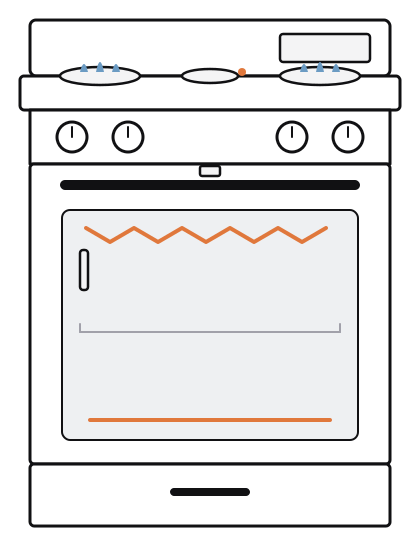
- Control board and touchpad
- Display or buttons not responding.
- Spark igniter
- Clicks but won't light.
- Burner switch
- Burner won't turn on, or won't turn off.
- Door lock
- Stays locked after self-clean.
- Broil element
- No broil, or uneven heat on top.
- Temperature sensor
- Oven runs hot or cold.
- Bake element or gas igniter
- Oven won't heat.
Oven questions
Do you repair high-end ranges?
Yes, including Viking and Thermador, gas and electric.
Can you fix a glass cooktop?
We replace the elements, switches and controls under the glass. A cracked top means a new top, and we'll price that before any work.
My gas oven's igniter glows. Doesn't that mean it works?
Not always. An igniter can glow and still be too weak to open the gas valve, and that's the most common reason a gas oven won't heat.
My oven smells like gas just before it lights. Is that safe?
Stop using it: that smell usually means a weak igniter is letting gas build up before it lights. If you smell gas when the oven is off, leave the house and call your gas company from outside. Don't switch lights or appliances on or off.
Do you work on wall ovens and cooktops?
Yes. Freestanding ranges, wall ovens and cooktops, gas and electric, coil and glass-top.
Do you install ranges and wall ovens?
Yes, wherever you bought it. Gas hookups aren't included.