XT Appliances · Hazel Park, next door to Warren
Refrigerator repair in Warren, MI
Most refrigerator calls are a warm fridge side, frost in the freezer, a leak or an ice maker that quit. Our technician diagnoses it at your home, and you approve the price in writing before any work.
- 25% off for seniors and veterans
- 90-day warranty
- Same-day most weekdays
What's your refrigerator doing?
Pick the symptom closest to yours to see what usually causes it and what you can safely check.
Freezer cold, fridge warm
Cold is being made but not moved, most often because the freezer fan has stopped or frost has choked the coil.
What it usually is
- Evaporator fan motorThis fan in the freezer pushes cold air through to the fridge side, so when it stops the freezer stays cold and the fridge warms. With the fridge running, open the freezer and hold its door switch in: no fan sound points here.
- Frost-choked coil from a defrost faultIf the defrost system fails, frost packs the cooling coil until air can't pass through. The fridge warms slowly over several days, and you may see frost caked on the freezer's back wall.
- Air damper stuck shutThe damper meters how much freezer air gets into the fridge. Stuck shut, it keeps the fridge warm even though the freezer fan runs normally.
- Door switchA stuck switch can leave the light on with the door shut, and the bulb's heat warms the fridge a few degrees. On some models it also stops the fan when it should run.
Try this first
- Make sure food isn't pressed against the air vents inside, so cold air can move from the freezer to the fridge.
- Check the temperature settings and that both doors close and seal.
- With the fridge door open, press the light switch button by hand. The light should go out.
- With the fridge running, open the freezer, hold its door switch in if it has one, and listen for the fan behind the back wall.
Stop using it and call now if
- Food has been above 40°F for two hours or more
- A burning smell, or the back is hot to the touch
Not cooling, clicking
A click every few minutes with nothing cold is most often a failed start relay, not a dead compressor.
What it usually is
- Compressor start relay and overloadThe relay gives the compressor its push to start. When it fails, the compressor hums, the overload clicks it off, and a few minutes later it tries again while nothing gets cold.
- Dirty condenser coilsThe coils let heat out of the refrigerator. Packed with dust or pet hair they trap it, so the fridge runs all the time and stays warm while the compressor runs hot.
- Condenser fan motorThis fan cools the coils and the compressor. If it seizes, the compressor overheats and keeps shutting itself off, the back feels very hot, and you can't hear the fan underneath.
- Inverter compressor control boardMany newer models drive a variable-speed compressor from a control board instead of a start relay. When the board fails, the compressor clicks every few seconds and won't start.
- CompressorThe compressor makes the cold, and it does fail, but far less often than the parts above. It's the last suspect, after the relay, the condenser fan and the coils check out.
Try this first
- Check the temperature settings in case a dial or button got bumped.
- Unplug it and vacuum the condenser coils if they're dusty.
- Leave space around the refrigerator so air can reach the coils.
Stop using it and call now if
- A burning smell, or the back is hot to the touch
- Food has been above 40°F for two hours or more
Frost or ice building up
Frost on the freezer's back wall usually means the defrost system has stopped clearing the coil, while frost around the door points at the seal.
What it usually is
- Defrost heaterThe heater melts the frost off the coil on each defrost cycle. When it burns out, frost builds a little more each cycle until it cakes the freezer's back wall and the fridge side starts to warm.
- Defrost thermostatThis small switch on the coil lets power reach the heater only while the coil is cold. Stuck open, it keeps the heater off, and the frost looks the same as a dead heater's.
- Defrost control or timerThe control decides when to defrost. If it never starts a cycle, the coil ices over even though the heater and its thermostat are fine.
- Door gasketA torn or flattened seal lets humid room air in, and the moisture freezes near where it enters. Frost around the door opening, sweating and constant running point here.
Try this first
- Note where the frost is: the back wall points at the defrost system, the edges of the door point at the seal.
- Close the door on a dollar bill in several spots. If it slides out easily, the seal is weak there.
- Make sure nothing inside is stopping the freezer door from closing all the way.
Stop using it and call now if
- The fridge side has started to warm
- Food has been above 40°F for two hours or more
Leaking water
Water inside or ice on the freezer floor is usually a blocked defrost drain, and water behind the fridge is usually the water supply or inlet valve.
What it usually is
- Blocked defrost drainMelt water from each defrost runs down a drain to a pan underneath. When ice or debris plugs it, the water backs up into puddles under the crisper drawers or an ice sheet on the freezer floor.
- Water inlet valve or supply lineThe valve at the back lets house water in for the ice maker and dispenser. If it weeps or doesn't close fully, water collects behind the fridge while the inside stays dry.
- Overflowing ice makerA valve that doesn't close all the way keeps feeding the ice mold, and a partly frozen fill tube makes the water miss it. Either way water spills into the bin and the cubes freeze into one block.
Try this first
- Note where the water is: under the drawers, on the freezer floor, at the front or behind the fridge. It helps us bring the right part.
- Shine a light behind the fridge and look for drips along the water line.
- If water is running from behind the fridge, close the water valve that feeds it.
- Check the ice bin for cubes frozen into a block or water sitting in it.
Stop using it and call now if
- Water pooling near an outlet or wiring
- Water keeps leaking behind the refrigerator
No ice or no water
Slow water with small cubes is usually an old filter, no ice and no water together point at the inlet valve, and one without the other points further along.
What it usually is
- Clogged water filterAn old filter chokes the flow to both the dispenser and the ice maker. The water trickles, the cubes come out small or few, and the filter is past six months.
- Frozen water tubeThe tube to the door dispenser or the fill tube over the ice maker can freeze solid. One side stops while the other works, and you may hear the valve try to fill with nothing coming through.
- Water inlet valveThe valve feeds both the ice maker and the dispenser, so when it fails both stop together. No water even with a fresh filter and the supply valve open points here.
- Ice maker moduleThe ice maker's motor, gears or mold thermostat can stop it cycling. Water still comes out at the door and the ice maker is switched on, but no new ice drops into the bin.
- Dispenser switch or paddleThe switch behind the pad tells the fridge to send water or ice. Press the pad and nothing at all comes out, yet the ice maker keeps filling the bin.
Try this first
- Replace the water filter if it's more than six months old.
- Make sure the ice maker is switched on. Many have an arm or a switch.
- Check that the water valve behind the refrigerator is open.
- Check that the freezer isn't set colder than it needs to be, which can freeze the water lines.
Stop using it and call now if
- Water leaking behind the refrigerator
- Water near an outlet or wiring
Stop using it and call now if:
- A burning smell, or the back is hot to the touch
- Water pooling near an outlet or wiring
- Food has been above 40°F for two hours or more
Refrigerator repair, diagnosed first
Most refrigerator calls turn out to be a part that moves cold air or clears frost, not the cooling system itself. A freezer fan, a defrost heater, a start relay or a clogged drain causes far more warm fridges and puddles than a failed compressor does.
Diagnosing first matters with refrigerators because several faults look the same from the outside. A fridge that clicks and won't cool sounds like a dead compressor, and it's usually the small relay that starts it. Frost from a burned-out defrost heater looks exactly like frost from a stuck defrost thermostat. Our technician tests the part before naming it, and you approve the price in writing before any work.
We work on built-in refrigerators too, including Sub-Zero, Viking and Thermador, and on ice makers in the door and in the freezer. If a repair doesn't make sense for an older fridge, we'll say so.
Where a refrigerator usually fails
The parts that fail most often, and what you notice when each one goes.
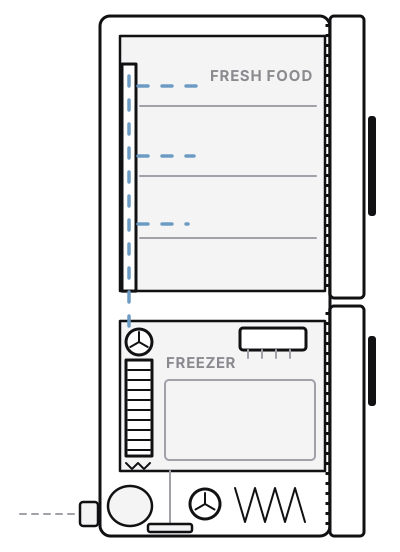
- Evaporator fan
- Freezer is cold, fridge is warm.
- Ice maker
- No ice, or small cubes.
- Door gasket
- Sweating, frost, or running all the time.
- Defrost heater
- Frost building up in the freezer.
- Defrost drain
- Water leaking inside or underneath.
- Compressor and start relay
- Clicking, and not cooling.
- Condenser coils and fan
- Runs all the time and stays warm.
- Water inlet valve
- Ice maker or water dispenser stopped.
Refrigerator questions
Is an older refrigerator worth fixing?
Often, yes. Most refrigerator faults are a fan, a defrost part or a control, not the sealed cooling system. If a repair doesn't make sense, we'll say so.
Do you work on built-in refrigerators?
Yes, including Sub-Zero, Viking, Thermador and other built-in models.
My fridge clicks and won't cool. Is the compressor dead?
Usually not. A repeating click with no cooling is most often the start relay, a much smaller part. We test the relay and the condenser fan before we look at the compressor.
What do I do with the food while it's warm?
Keep the doors shut and move what you can to a cooler. If food has been above 40°F for two hours or more, call us now.
How often should I change the water filter?
About every six months. An old filter slows the water, which gives a trickle at the door and small cubes or none. If a new filter doesn't fix it, call us.
Should I clean the condenser coils?
Yes, if they're dusty. Unplug the fridge first and vacuum them. Dust on the coils traps heat, so the fridge runs longer and cools less.